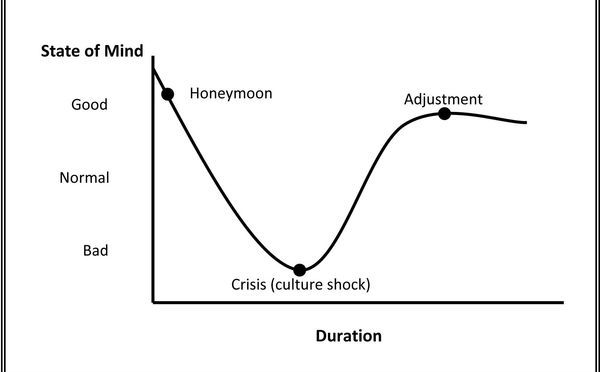
Anyone can tell you that adjusting to a new place takes time. It takes even longer when you are in a new country and culture. In fact, there is a whole science to explain the ebbs and flows one faces while adjusting to a new culture. Many of you may be familiar with the culture shock (cultural adjustment) curve describing the various stages of the intercultural journey… For those less familiar, it is a squiggly line explaining the highs and lows of leaving your comfort zone.
For some this journey is dramatic. Call me a sage, a pro, emotionally desensitized or acutely self-aware, but it appears that a lifetime of international travel and living abroad has resulted in more subtle ebbs and flows. This means that I am less reactive to my new surroundings: my honeymoon period is less “wows and OMGs” in amazement and bewilderment and more “cools,” usually because I have seen something similar before. Similarly, my culture shock is less severe: it may last mere minutes or hours rather than days, weeks or months. In fact, sometimes I am not aware that I have been affected by an incident until various issues have accumulated and I burst with a confusing mixture of emotional responses: angry outbursts, tears, uncontrollable laughter. Needless to say, it is not an attractive look.
On a more practical level, after a month in Kampala I find myself counting the “wins” (and losses) of transitioning to a new place. These so-called wins are usually very simple, mundane events that get me excited because they are a step towards feeling at home:
- Knowing multiple ways to get to my destination
- Figuring out how to open the tricky bathroom door at work
- Memorizing at least one of my mobile numbers (I have 3)
- Found a local delicacy that I enjoy – yay for salty matoke (banana) chips
- Determining which mobile plan promotions/bundles will save me the most money
- Finding cheap snacks in the neighbourhood (why make chapatis when I can buy them for less than 25 cents each?)
- Successfully bargaining for fruits and vegetables, transportation, souvenirs…
- Becoming a “regular” at a restaurant (I got a loyalty card)
- Knowing when and where to buy my groceries
Similarly, I have list where I have been “beaten” by my new surroundings:
- Getting ripped off for fruits and vegetables, transportation, souvenirs… (x 10)
- Feeling lost, confused or excluded as an outsider (x 1000)
- Asked to give money because I am a foreigner (x 100)
- Telling a woman exactly what I thought of her when she pushed me out of the way and stole my seat in a matatu (a shared van taxi)
- Aggressively hit-on in the hopes that I will be the token “white” notch in a guy’s belt – he asked if I felt inspired by my Dutch housemate and her Ugandan boyfriend
- Catch some weird stomach bug (probably brought it with me already)
- Inhabited by a new creature of some kind (bacteria, virus, insect, etc.)
So far, I feel things are pretty even (ok, Kampala may have a few up on me). Luckily, I have had no real breakdowns yet and I have already found a support network and a restaurant with comfort food if (and when – it is inevitable) I hit my cultural wall.
 The Little Global Nomad